Specifying Luxury Upholstery for Restaurants: Velvet, Mohair, Wool and Leather (2026)
How to choose velvet, mohair, wool and leather for restaurant banquettes: Martindale rub ratings, fire rules (BS 5852, BS 7176, CAL TB 117-2013) and cleaning.
Short answer: For fine-dining banquettes, choose a contract-grade covering with a Martindale abrasion result of at least 40,000 rubs (or 30,000+ Wyzenbeek double rubs in the US), confirm it meets the fire test your jurisdiction requires as a composite with the foam you will use (BS 5852 sources for BS 7176 medium hazard in UK restaurants; CAL TB 117-2013 in California), and match the material to how the room is used: leather and tight velvets for heavy service, mohair for longevity and depth of colour, wool for warmth and natural flame resistance.
Luxury upholstery in a restaurant has to look extraordinary under candlelight and survive hundreds of sittings a month. This guide explains how to balance the two, with the numbers that matter.
What does "contract grade" actually mean?
There is no single legal definition. In practice a contract or commercial upholstery material is one that has been tested and is intended for public spaces: it publishes an abrasion result, a pilling grade, colour-fastness figures and fire-test results, and its maker states the uses it is suitable for. A beautiful domestic velvet without that data is a risk in a restaurant, however expensive it is.
Abrasion: Martindale and Wyzenbeek
- Martindale (EN ISO 12947-2) rubs the fabric in a figure-of-eight against a standard abradant until threads break or appearance changes. Results are given in cycles ("rubs").
- Wyzenbeek (ASTM D4157) is the American method, a back-and-forth rub giving "double rubs". The two are not directly convertible.
| Use | Martindale (rubs) | Wyzenbeek (double rubs) |
|---|---|---|
| Light domestic, decorative | 10,000–15,000 | under 15,000 |
| General domestic | 15,000–25,000 | 15,000 |
| Heavy domestic / light contract | 25,000–40,000 | 15,000–30,000 |
| General contract (restaurants, hotels) | 40,000+ | 30,000+ |
| Heavy contract, high-turnover seating | 50,000–100,000+ | 50,000+ |
These bands reflect common industry guidance; the fabric maker's own suitability statement takes precedence. Abrasion is not the only measure of durability: pilling (graded 1–5, aim for 4 or above), seam slippage and colour fastness to rubbing and light matter as much on a banquette that gets sat on all evening and sits near a window all day.
Fire performance: what applies where?
Fire rules are jurisdiction-specific and apply to the combination of cover, interliner and filling, not to the fabric alone. Always confirm the requirement with your fire officer, building control or authority having jurisdiction.
United Kingdom
- BS 7176 sets out the ignitability performance required for seating in non-domestic premises according to hazard level. Most restaurants, hotels and bars are classed as medium hazard.
- Medium hazard under BS 7176 requires the cover and filling combination to pass BS 5852 ignition sources 0 (smouldering cigarette), 1 (match-flame equivalent) and crib 5 (a small wooden crib, a more severe source).
- In practice this means combustion-modified high-resilience (CMHR) foam, and covers that either pass inherently or are back-coated or used with a fire-barrier interliner.
- The Furniture and Furnishings (Fire) (Safety) Regulations 1988 apply to domestic furniture and are a separate regime.
European Union
There is no single harmonised furniture fire regulation for restaurants. Commonly referenced tests are EN 1021-1 (cigarette) and EN 1021-2 (match-flame equivalent), with national requirements on top. Rules differ between member states and between building types.
United States
- CAL TB 117-2013 is California's smoulder-resistance standard for upholstered furniture. It tests cover and filling against a smouldering cigarette and does not require flame-retardant chemicals; California law also requires labelling on whether flame retardants were added.
- Some public occupancies and jurisdictions require CAL TB 133 or NFPA 260/261-type tests. Check with your fire marshal.
Our practice at Maison Banquette (a line by EASEN Commercial Furniture) is to specify fire-retardant foams and suitable covers to the destination market's rules on request, and to supply test reports for the specific item where available.
Material by material
Cotton and blended velvet
Velvet has a cut pile that catches light and gives saturated colour. Contract velvets are typically tightly woven with cotton, polyester or blended piles and can reach 40,000–100,000 Martindale rubs. Watch for pile crush and shading: velvet changes tone with the direction of the pile, so specify the pile direction on the drawing (normally running down the back and toward the front of the seat) and keep it consistent across sections.
Mohair velvet
Mohair, from the Angora goat, makes one of the most durable natural upholstery velvets. Its fibres are resilient and springy, resist crushing, take dye with exceptional depth and are inherently harder to ignite than many synthetic fibres. Mohair velvets have long been used on theatre and rail seating for these reasons. It is expensive and the cost shows on long runs, so it is often specified for signature booths and end faces, with a compatible contract velvet elsewhere.
Wool and wool blends
Wool is naturally more flame-resistant than most textile fibres because of its high moisture and nitrogen content: it is hard to ignite, tends to char rather than melt, and often self-extinguishes. Many pure-wool contract fabrics pass cigarette and match tests without back-coating, but meeting crib 5 still depends on the full composite (foam, interliner and cover) or on a flame-resistant finish. Wool feels warm, absorbs some sound and resists soiling well. Bouclé wools are fashionable but loops can snag on jewellery and bag buckles; choose a tight bouclé with a published abrasion result.
Leather
Leather is not tested on Martindale in the same way; its durability is judged by the leather type and finish.
| Leather type | Character | Restaurant suitability |
|---|---|---|
| Full aniline | Soft, natural, shows every mark | Low; best for private rooms with gentle use |
| Semi-aniline | Natural look with light protective coat | Good with regular care |
| Pigmented / corrected grain | Uniform colour, protective finish | Excellent for high-turnover rooms |
| Nappa | Soft, smooth, usually pigmented or semi-aniline | Very good, premium feel |
| Embossed | Pattern pressed into surface | Very good; no seams on face |
Leather wipes clean, does not trap crumbs and ages with character. Ask for the hide's finish type, thickness (typically 1.0–1.4 mm for upholstery) and any fire test results with your foam.
Faux leather and performance coated fabrics
Polyurethane and vinyl-coated fabrics are wipe-clean and economical. Quality varies widely: ask for abrasion (often a Wyzenbeek or Martindale figure), hydrolysis resistance for PU, and cold-crack performance. They suit grills and high-volume rooms and are a sensible choice for seats paired with a velvet back.
Comparison at a glance
| Material | Look under low light | Cleaning | Durability in service | Relative cost |
|---|---|---|---|---|
| Contract velvet | Rich, light-catching | Vacuum, spot-clean | Good to very good | Medium |
| Mohair velvet | Deepest colour | Vacuum, spot-clean | Excellent | High |
| Wool / wool blend | Warm, matte | Spot-clean, resists soiling | Very good | Medium–high |
| Semi-aniline leather | Soft sheen | Wipe and condition | Good | High |
| Pigmented leather | Even sheen | Wipe clean | Excellent | Medium–high |
| Performance faux leather | Uniform | Wipe clean | Good to very good | Low–medium |
A specification checklist
- Confirm the fire requirement for your jurisdiction and building, in writing, before choosing the covering.
- Get the data sheet: abrasion, pilling, colour fastness, fibre content, fire tests and suitability statement.
- Check the width and repeat: 137–140 cm is a typical upholstery width; large repeats increase waste and COM quantity.
- Decide pile direction for velvets and note it on the drawings.
- Request a cutting and, for large orders, a strike-off or reserve of the same dye lot.
- Specify seats and backs separately if helpful: hardwearing seat, more decorative back.
- Approve a sample in the real material with the real foam.
- Write the cleaning instructions into the handover for the restaurant team.
For a full view of how these coverings are applied to couture banquette backs and period booths, see our collections.
Common mistakes
- Choosing the fabric before confirming the fire rule. Changing foam or adding an interliner late in the process changes cost, firmness and appearance.
- Testing the fabric alone. Fire tests apply to the composite; a fabric "passing" on one foam may fail on another.
- Using full-aniline leather on busy seats. It marks quickly and needs more care than most restaurant teams can give.
- Ignoring pile direction. Mismatched velvet sections look like two different colours.
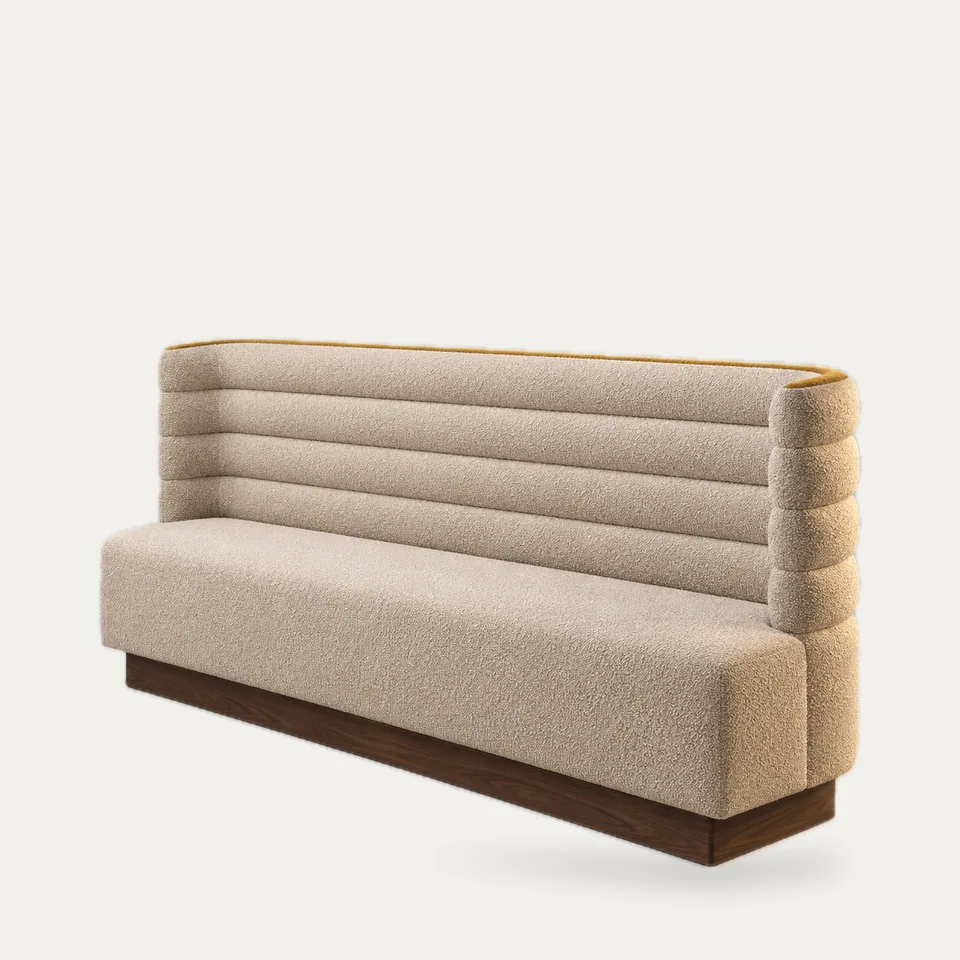
- Underestimating COM quantity. Channels, welts and pattern matching consume more fabric than a plain back; we calculate yardage from the drawing.
- Specifying a loose bouclé for seats. Large loops snag on bags and jewellery.
FAQ
How many Martindale rubs does a restaurant banquette fabric need?
A common benchmark for general contract use is 40,000 Martindale rubs or more, with 50,000–100,000 for heavy-use seating. Always check that the maker states the fabric is suitable for contract seating.
Is velvet practical for a busy restaurant?
Yes, if it is a contract velvet with a high abrasion result and good pile recovery. Mohair and tightly woven polyester or blended velvets cope best. Specify pile direction and vacuum regularly.
Does wool need flame-retardant treatment?
Wool is inherently more flame-resistant than most fibres and many wool fabrics pass cigarette and match tests untreated. For stricter tests such as BS 5852 crib 5, the composite with foam and interliner, or a flame-resistant finish, may still be required.
Is CAL TB 117-2013 the same as BS 5852?
No. CAL TB 117-2013 is a smoulder test for California; BS 5852 defines several ignition sources, and UK contract seating usually has to pass sources 0, 1 and crib 5 under BS 7176 medium hazard. A product meeting one does not automatically meet the other.
Can I use my own fabric (COM)?
Yes. Send the data sheet first so we can check abrasion, width, repeat and fire performance, then ship the material. We calculate the quantity from the approved drawings.
Send us a floor plan, elevation or sketch with approximate run lengths and the look you have in mind. We will reply with questions or an itemised quote and a drawing schedule.
Request a quote